Finishes
Custom colour and painted finishes
Raw MDF, plywood raw or painted, laminate, or two-pack paint matched to your exact brand colour. What each finish costs you in money, in time, and in how it holds up.
Why the finish decides the lead time
Finish is the one choice on a Clikt order that changes almost everything downstream: the price, how long it takes to make, how it survives a season of events, and whether it reads as your brand or just as furniture.
It is worth understanding before you order, because a two-pack painted piece cannot be hurried. Paint is sprayed and then cured, and cure time is chemistry rather than effort. Deciding on a colour late is the single most common reason an order lands closer to an event date than anyone wanted.
The four finishes, and who each one is for
-
Raw MDF
The cheapest and fastest, and the one most open to your own touch. Panels arrive raw and ready to assemble, so the surface is yours to paint, wrap or vinyl in your own style. MDF is also the ideal base for paint, taking a smooth, flawless finish with no grain telegraphing through, which is why it sits under every painted piece we make. A budget friendly pick if you are skinning the piece in brand graphics anyway, running a one off campaign, or you simply want to add your own flair. It is not sealed, so keep it out of the rain and away from spilled drinks.
-
Raw and painted plywood
Tougher than MDF and noticeably lighter to carry, which matters on a bump in. Left raw it shows its layered edge, a distinctive detail that reads as considered rather than something to hide, and it takes paint just as well when you want the strength without the timber look. A good pick where the piece gets handled a lot, moves between events, or the material itself is part of the design.
-
Laminate
The workhorse, and not just white. Laminate comes in a wide range of colours and finishes, including timber and marble looks, so you get colour choice and durability without the cost of paint. It resists knocks and splashes, wipes clean and looks the same on the last day of a season as the first. If a piece is going to tour, be handled by casual staff, or serve food and drink, this is usually the right answer. One limitation: it cannot follow a machined profile, so a V groove or a shaped face has to be painted instead.
-
Two-pack paint
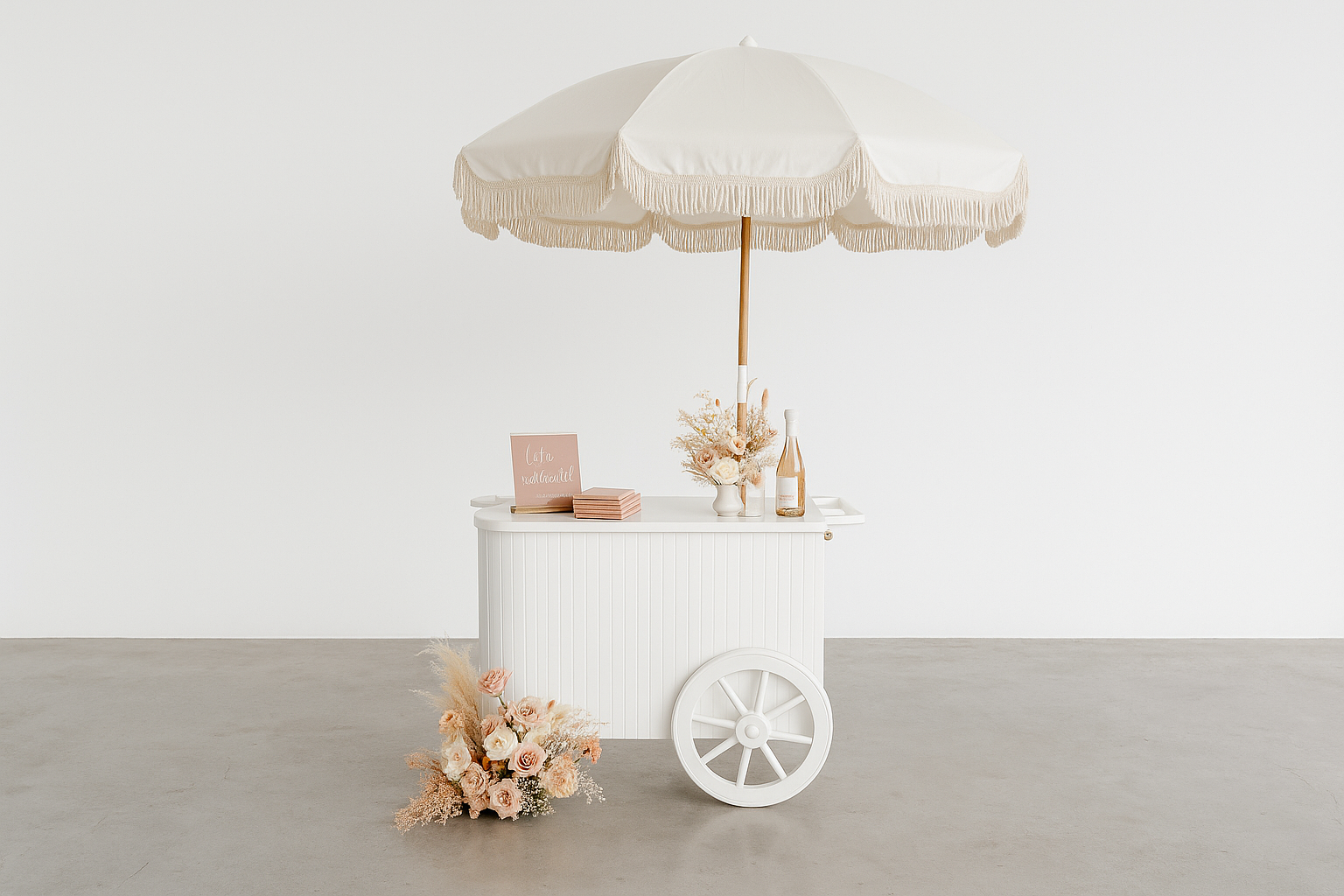
Sprayed, cured and furniture grade. Deeper and more even than laminate, and the finish that photographs best. It is matched to your colour from a Dulux, RAL or NCS reference, and it is the only finish that can follow a machined profile, so anything with a V groove or a shaped face is painted. Choose it when the piece appears in content, sits in a premium retail environment, or needs to look built in rather than brought in. This is how a cart stops looking like furniture and starts looking like your brand. It carries a premium and the longest lead time of the four.
Matching a brand colour properly
Send a paint reference rather than a screenshot. A Dulux, RAL or NCS code is an unambiguous physical standard; a hex value from a brand guide is a screen colour, and screens disagree with each other and with paint.
If all you have is a hex, we can work from it, but treat the result as an interpretation rather than a match. Where a piece has to sit alongside existing branded fixtures, the safest path is to send us a physical sample (a panel, a swatch, even a printed piece) and we match to the object.
One honest limitation: what you see on a screen is never exactly what comes off the gun. Monitors are backlit and paint is not. We would rather say that up front than have you compare a cart to a mockup.
What the premium actually pays for
People often assume a painted finish costs more because paint costs more. It does not, much. What you are paying for is workshop time and floor space.
A two-pack piece is sanded, primed, sprayed in a booth, cured, checked, and often sprayed again. Every one of those steps occupies a bay that could otherwise be cutting the next order, and cure time cannot be compressed by working harder or later. A custom colour adds mixing and a test panel on top, because nobody sprays a full set of panels to an unverified colour.
The practical consequence is that the premium is roughly flat per piece rather than proportional to size, so it stings least on larger items and on runs of several units. If budget is tight and the piece is going to be wrapped in graphics anyway, raw MDF and a good vinyl will get you further than paint will.
One more thing worth knowing: a handful of pieces are kept finished in premium white and held in stock, so they ship in three days rather than waiting on production. If your date is tight, ask what is on the shelf before you commit to a colour.
Looking after each finish
Raw MDF: keep it dry. Seal or paint it before outdoor use. Store flat and off concrete.
Laminate: a damp cloth and mild detergent. No solvents, no abrasive pads. Edges are the vulnerable part, so stack panels face to face rather than face to edge.
Two-pack paint: a soft cloth and warm water. Wipe spills rather than letting them sit. Transport with a blanket or the supplied packaging between panels; the finish is hard but a loose castor in the back of a van will still mark it.
All four pack down flat, which is the real protection: a collapsed piece in a cupboard cannot be knocked by a trolley.
Available in every finish


Common questions
How long does a custom colour take?
Two-pack painted pieces run roughly three to four weeks in production, against one to two weeks for raw and two to three weeks for laminate. A custom colour is at the longer end of that because the paint is mixed and tested before anything is sprayed.
Can I paint raw MDF myself?
Yes, and plenty of customers do. Order raw, seal the panels first, then finish with your chosen paint. Prime the cut edges as well as the faces. MDF edges are thirstier than the flat surfaces and will look patchy otherwise.
Is there a minimum order for a custom colour?
No. A single piece can be sprayed to your colour. The premium reflects the setup and cure time rather than volume, so the cost per piece drops on larger runs.
Can you match a colour from a photo?
We can work from a photo, but only as a starting point. Photographs shift colour with the light they were taken in. A Dulux, RAL or NCS code, or a physical sample posted to the workshop, is the only way to get a true match.
Will the finish chip if it gets knocked?
Two-pack is a hard, furniture-grade finish and handles normal event use well. It is not indestructible. If a piece is going to be handled by rotating casual staff every weekend, laminate is the more forgiving choice.
Know your colour?
Send us the reference and what you are building, and we will confirm the finish, the price and a real production window before you commit.